Rice production in Pakistan faces three measurable climate pressures: shifting monsoon timing that disrupts planting schedules, temperature extremes that exceed the 20-35°C optimal range for rice development, and more frequent extreme weather events outside historical norms. These changes affect every stage of rice production—from seed germination through post-harvest handling—and the assumption of stable weather patterns that guided agricultural planning for generations no longer holds.
Understanding climate impacts enables better preparation. This article examines how weather patterns affect rice physiology and yield, then discusses practical strategies for building resilience into farming operations.
Temperature Effects on Rice Development
Rice's temperature requirements aren't arbitrary—they're the result of millions of years of evolution adapting the species to specific climate niches. When temperatures deviate from optimal ranges, physiological processes suffer in ways that directly impact yield and quality.
The critical temperature thresholds for rice are more precise than commonly understood:
- Below 20°C: Tillering slows significantly; grain filling extends beyond normal duration
- 20-35°C: Optimal range for most growth stages
- Above 35°C: Spikelet fertility drops sharply; photosynthesis rates decline
- Above 40°C: Direct tissue damage; yield losses become severe
Heat stress during flowering is particularly damaging. The microsporogenesis stage—pollen development inside the plant—occurs shortly before heading and is exquisitely sensitive to temperature. When daytime temperatures exceed 35°C during this period, pollen viability drops, leading to increased spikelet sterility and blank grain. This damage can't be reversed once it occurs; it's permanent yield loss for those specific grains.
Night temperatures deserve attention that they rarely receive. While farmers naturally focus on daytime heat stress, research over the past two decades shows night temperatures also significantly affect rice yield. Warmer nights increase respiration rates, burning photosynthate that would otherwise go to grain filling. High night temperatures during grain filling consistently reduce grain weight—a less visible but real yield component.
Rainfall Patterns and Water Management
Traditional rice cultivation assumes reasonably predictable monsoon timing—rainfall concentrated in summer months that coincides with rice's water-demand period. Climate change disrupts this fundamental assumption, shifting when rains arrive and how intensely they fall.
Delayed monsoon onset affects planting dates directly. Rice varieties are bred for specific maturation windows—plant too late and grain filling occurs in cooler temperatures that reduce yield and extend maturity beyond acceptable periods. When monsoon delays push planting from the optimal window, farmers face difficult decisions about variety choice, accepting lower yield potential or risking frost damage at season end.
More concerning than delayed onset is rainfall variability. The same total seasonal rainfall concentrated in fewer, more intense events creates different problems than steady moderate rainfall. Heavy rainfall causes flooding damage, nutrient leaching, and soil erosion. The intervals between heavy events may be dry enough to stress crops despite adequate total rainfall.
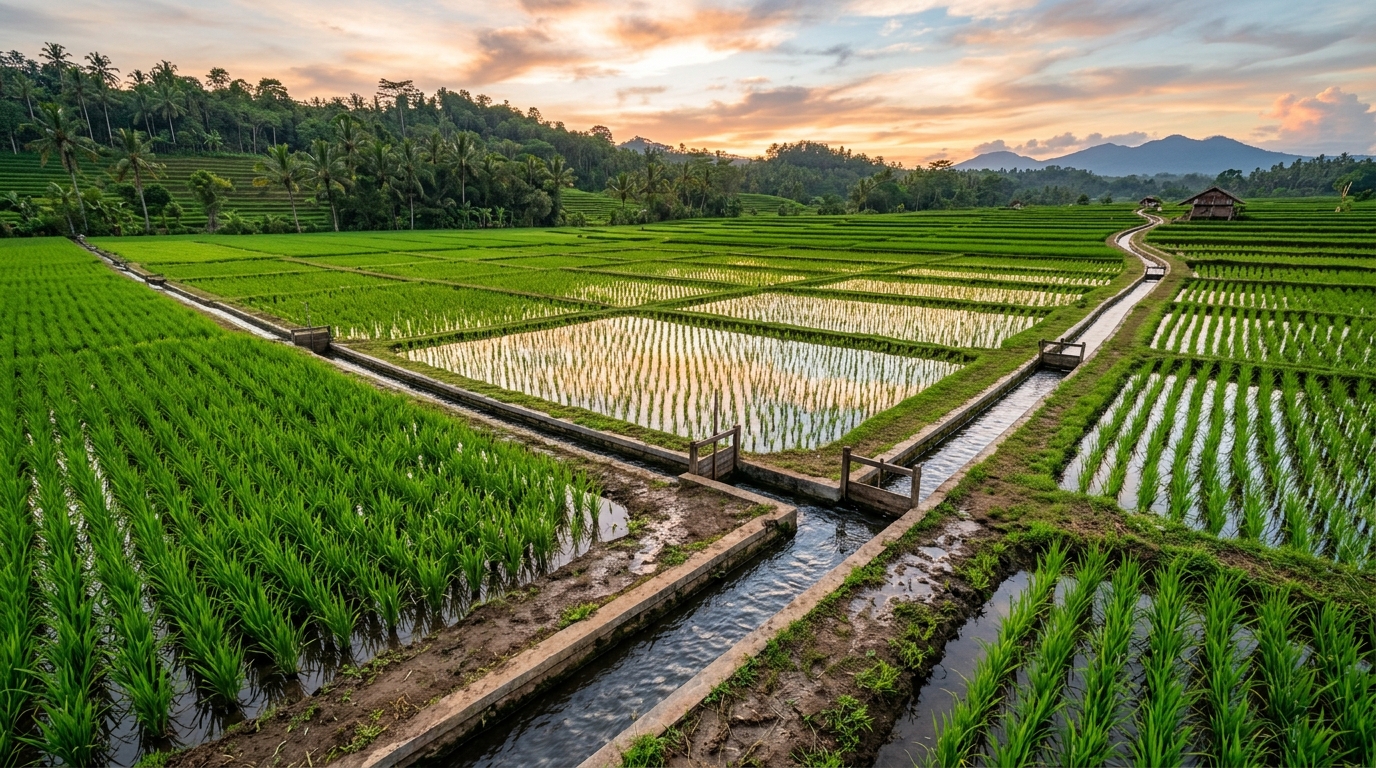
Adapting to variable rainfall requires flexibility in water management. Building larger farm reservoirs provides buffer against dry spells between rainfall events. Improving drainage alongside irrigation capacity enables managing both excess and deficit conditions. The farms best positioned for climate resilience are those that can handle water surplus and shortage with equal facility.
Extreme Weather Events and Rice Systems
Climate change increases the frequency of extreme weather events—that's one of the most robust conclusions in climate science. Rice systems face specific threats from floods, droughts, cyclones, and unseasonal events that fall outside normal production calendars.
Flash flooding submerges young rice plants completely for extended periods. Rice can survive complete submergence for approximately 7-10 days if water is clear and temperatures moderate, but flooding during Tillering causes significant mortality. Flooding during flowering causes grain sterility. The recently developed submergence-tolerant varieties—IR64 Sub1 and related cultivars—provide meaningful but not complete protection against typical flood events.
Drought stress has different but equally serious effects. Extended periods without rainfall or irrigation during critical growth stages cause direct yield loss through reduced tillering, increased spikelet sterility, and lower grain weight. The economic impact of drought is often larger than immediate yield loss because farmers may spend scarce resources on irrigation that proves inadequate anyway.
Cyclones and associated storm surge affect coastal rice areas directly. Salt-laden winds and storm surge flooding introduce salinity to fields that may require seasons to remediate. The economic damage from a single severe cyclone can exceed several years of production value in affected areas.
Carbon Dioxide and the Fertilization Effect
Climate change brings some apparent benefits alongside its challenges. Elevated atmospheric carbon dioxide concentrations—now exceeding 420 ppm compared to pre-industrial levels around 280 ppm—function as a fertilizer for rice and most other C3 crops. This fertilization effect increases photosynthetic rates and biomass production.
Field experiments in Free Air Carbon Dioxide Enrichment (FACE) facilities confirm rice yield increases of 10-15% from CO2 elevation alone under good growing conditions. However, the benefit diminishes when other factors become limiting—drought stress, nutrient deficiency, pest pressure—so the actual yield benefit depends heavily on how well other management factors are optimized.
Counteracting the positive CO2 effect is temperature elevation. The same emissions driving CO2 increase also warm the atmosphere, raising temperatures into ranges that partially or fully offset the CO2 benefit. Global projections suggest that tropical rice regions may see neutral to negative yield effects from combined CO2 elevation and warming by mid-century, despite the CO2 fertilization effect.
Building Climate Resilience in Rice Systems
Adaptation strategies for climate resilience span genetic, agronomic, and institutional levels. At the farm level, several practices provide meaningful protection against climate variability:
Variety selection matters more as climate variability increases. Rather than selecting varieties purely for maximum yield under ideal conditions, climate-smart variety choice considers performance across a range of conditions. Mixing early, mid, and late-maturing varieties spreads risk across the season—if one planting window experiences adverse weather, others may perform better. This portfolio approach to variety selection provides yield stability even when individual variety performance varies.
Water management flexibility is essential. Farms that can both drain excess water quickly and provide supplementary irrigation during dry periods handle variable rainfall better than those optimized only for average conditions. Investments in drainage infrastructure and water storage pay dividends in climate-stressed years.
Soil health improvement provides insurance against multiple climate stresses. Soils with good organic matter content drain better in wet periods, retain moisture better in dry periods, and support root systems that better withstand lodging from windstorms. Building soil health requires multi-year commitment but provides benefits across all future seasons.
Weather-linked crop insurance transfers some climate risk to insurers, enabling investment in production that would otherwise be too risky. While crop insurance markets remain underdeveloped in many regions, their development represents an important institutional adaptation to climate variability.
Regional Projections for South Asian Rice Systems
Climate projections for South Asian rice-growing regions suggest continued warming, increased rainfall variability, and more frequent extreme events. While the precise magnitude of change depends on global emissions trajectories, the direction of change is clear.
Temperature projections show continued warming through the century regardless of emissions reductions, with the rate of warming depending on mitigation efforts. Growing seasons may shift as winter temperatures become warm enough for rice production earlier in the year, though frost risk in traditional growing regions may also change.
Rainfall projections show greater uncertainty than temperature projections. Most models suggest increases in total annual rainfall but with greater variability and more concentrated heavy events. The timing of monsoon onset and retreat may shift, potentially lengthening or shortening the effective growing season depending on regional specifics.
Sea level rise threatens coastal rice areas with increased salinity intrusion and more frequent tidal flooding. Areas currently producing rice may face transition to brackish water or salt-tolerant crops, with significant economic disruption for affected farming communities.
Conclusion
Climate change transforms rice farming from an occupation assuming predictable weather to one requiring active risk management. The farmers and agricultural systems that thrive in coming decades will be those that build flexibility, resilience, and adaptability into their operations rather than optimizing purely for average conditions. water management strategies that build resilience against climate variability.
The challenge is substantial but not insurmountable. Agricultural science provides tools—tolerant varieties, improved water management, climate-smart agronomic practices—that weren't available to previous generations. What remains is implementing these tools at scale and building the institutional support structures that enable individual farmer adaptation, as outlined in international rice research. The floods of 2010 taught us that assuming stable climate was a mistake. The question now is how quickly we'll adapt to the new reality.